At this point in the conversation, someone sensible usually clears their throat.
“Okay,” they say. “I can see what you’re aiming at. But surely this is where it all starts to fall apart.”
And that’s a fair instinct.
Any time you propose a new institution — especially one dealing with ethics, long-term judgement, or constitutional restraint — the more important question isn’t what’s it meant to do? but how does it fail?
So let’s do that stress-test properly, rather than pretending good intentions are enough.
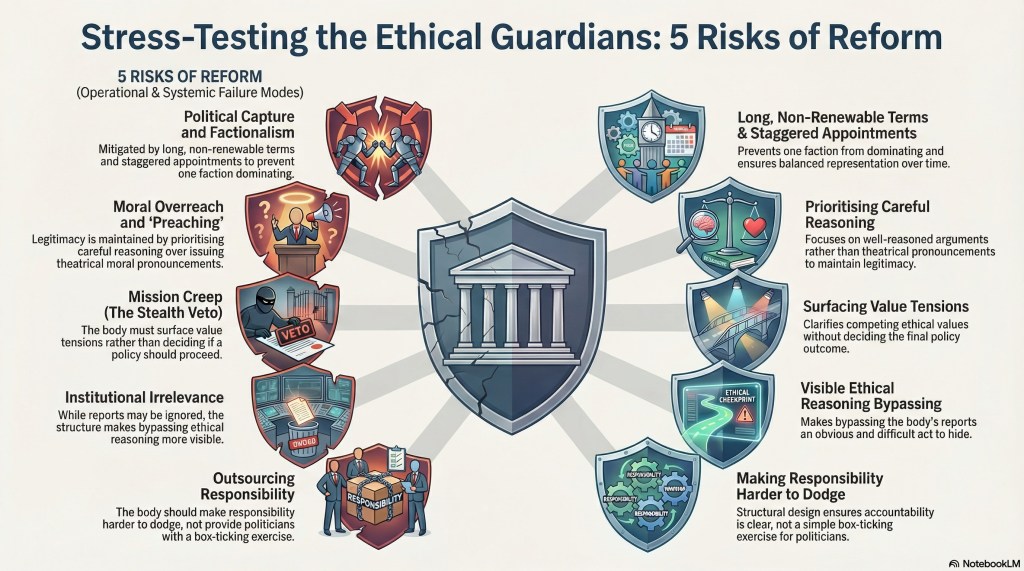
The first failure mode: it gets ignored
The most obvious risk is that nothing really changes.
You create a thoughtful, careful body. It produces measured analysis. It publishes reports. And then the House of Commons thanks it politely and carries on exactly as before.
That’s not a theoretical risk — it’s how a lot of advisory bodies end up.
But here’s the thing: that’s already happening now, just in a messier way. Ethical concerns are being raised. They’re just being raised late, inconsistently, and inside arguments about the House of Lords instead of out in the open.
The question isn’t “will it always be listened to?” It’s whether it makes ignoring ethical reasoning more visible and more deliberate than it is now.
Being ignored isn’t the worst outcome. Being quietly bypassed is.
The second failure mode: it gets captured
The next worry people raise is capture.
What if one political faction gradually stuffs it with allies?
What if one moral framework dominates?
What if it becomes the ethical wing of whoever happens to be in power?
This is where structure matters more than rhetoric.
Long, non-renewable terms. Staggered appointments. Multiple appointment routes. And a clear expectation of pluralism rather than consensus. All of that makes capture slower, noisier, and harder to deny.
It doesn’t make abuse impossible. But it does mean abuse leaves fingerprints.
That’s usually the best you can do in constitutional design.
The third failure mode: it turns preachy
There’s a real risk that a body explicitly dealing with ethics starts to sound like it’s telling people how to live.
If it slips into issuing moral verdicts, grand statements, or theatrical condemnations, it loses legitimacy very quickly. Politicians stop engaging. The public switches off. And the whole thing gets dismissed as out of touch.
That’s why the earlier emphasis on dullness matters.
If its output looks more like careful reasoning than moral pronouncements — more explanation than judgement — it’s much harder to caricature. It doesn’t need to tell anyone they’re wrong. It just needs to make the consequences harder to pretend weren’t understood.
The fourth failure mode: it becomes a veto by stealth
Another legitimate fear is mission creep.
Even without formal powers, a body can start acting as if it has a veto — by framing issues in absolutist terms, or by implying that disagreement is immoral rather than contested.
That would be corrosive.
The safeguard here is clarity about role. Its job isn’t to decide whether something should happen. It’s to surface what values are in tension, what harms might follow, and where trade-offs are being made.
Disagreement isn’t a failure of ethics. It’s the raw material of it.
The fifth failure mode: it lets everyone else off the hook
There’s one more risk that’s easy to miss.
If you create a separate place for ethical reasoning, politicians might quietly outsource responsibility to it. “That’s their job now,” the thinking goes. “We’ve had the ethics report — box ticked.”
That would be a mistake.
The whole point of this exercise isn’t to move responsibility away from elected representatives. It’s to make that responsibility harder to dodge.
If anything, it raises the bar. Once ethical risks are set out clearly, choosing to ignore them becomes a conscious act rather than a convenient blind spot.
So… does it survive the stress-test?
None of these risks are imaginary. Every one of them has happened somewhere, in some form.
But the uncomfortable truth is that most of them already exist in the current system — just without being acknowledged. Ethics is already ignored, captured, personalised, politicised, and muddled together with procedure.
The difference here is visibility.
A clearer structure doesn’t guarantee better outcomes. But it does make failure easier to see, easier to argue about, and harder to hide behind tradition or confusion.
Why this still matters
If you come away from this thinking, “Yes, this could go wrong,” that’s the right reaction.
The real question is whether the current arrangement is failing more quietly — and with less accountability — than a more deliberate one would.
Which brings us to the next step.
Before we try to conclude anything, it’s worth asking a simple comparative question: has anyone else tried something like this before — or would we be flying completely blind?
That’s where we’ll go next.o next.
This is post 12 of a series – Let’s Rethink The Lords, looking at the Upper House in the English system of politics. It will cover what it is, why it is, how it has changed, how other countries do it and potentially what could be done to improve ours.
There will be podcasts over at hysnaps-political-investigations providing explainers and summary videos at youtube @hysnapmmh, these are usually released a week or two after the Blog Post.
Discover more from Hysnaps Politics, Gaming, Music and Mental Health
Subscribe to get the latest posts sent to your email.

