
At this point in the conversation, it’s reasonable to pause and ask whether we’ve drifted into fantasy territory.
Whenever a new institution is sketched out — especially one dealing with ethics, long-term judgement, or constitutional restraint — the instinctive reaction is often: this all sounds very British and very theoretical… but does anyone actually do this?
The reassuring answer is yes.
The equally important answer is that they don’t do it in exactly the way we’ve been describing.
What exists elsewhere isn’t a single blueprint, but a set of partial solutions to the same underlying problem.
Ethics bodies that sit alongside politics
Several countries already separate ethical reasoning from day-to-day legislative combat, even if they do it in different ways.
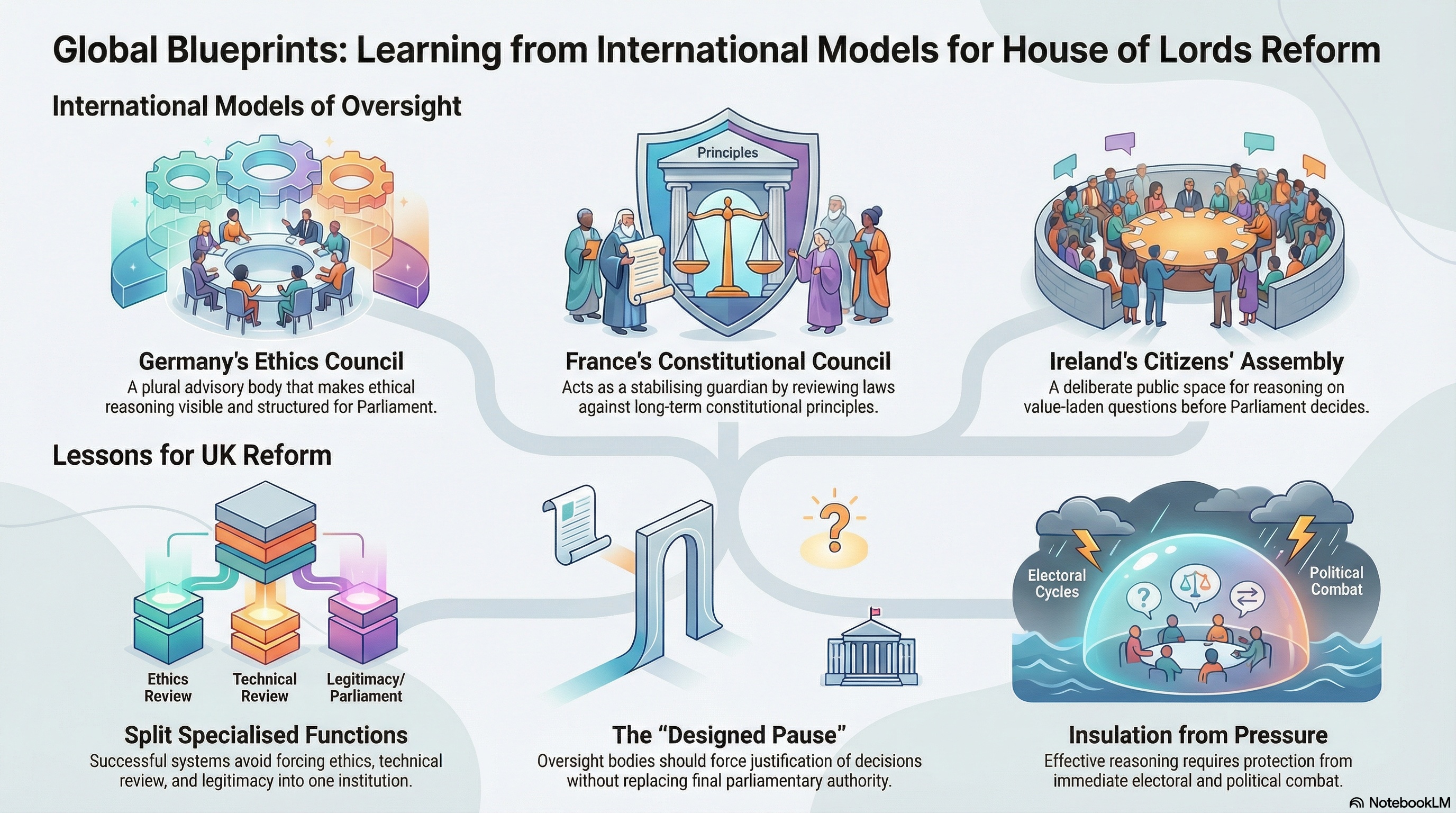
In German Ethics Council, for example, ethical questions around medicine, technology, and long-term societal impact are examined by a standing body that is explicitly plural and deliberately advisory. It doesn’t veto laws. It doesn’t tell Parliament what to do. But its work feeds directly into public debate and parliamentary consideration.
What’s interesting isn’t that it always changes outcomes — it doesn’t — but that ethical reasoning becomes visible, structured, and cumulative rather than episodic.
That already overlaps strongly with what we’ve been arguing for.
Constitutional guardianship without day-to-day politics
France takes a different approach.
The Constitutional Council isn’t an ethics body as such, but it plays a similar stabilising role by reviewing legislation against long-term constitutional principles rather than immediate political pressures.
It sits outside electoral politics, has fixed terms, and derives its authority from restraint rather than activism. Again, the point isn’t that it always blocks bad decisions — it doesn’t — but that it forces a pause and a justification when core principles are at stake.
That idea of a designed pause turns up again and again.
Deliberative bodies and citizens’ assemblies
There’s also a third category that’s closer in spirit than in structure.
Ireland’s Citizens’ Assembly showed that it’s possible to create spaces where ethical and value-laden questions are discussed deliberately, slowly, and in public, without those spaces being elected chambers or permanent authorities.
Those assemblies weren’t perfect. They didn’t replace Parliament. But they demonstrated that taking ethics seriously doesn’t require turning everything into party conflict or moral theatre.
They also showed the value of separation: the assembly reasoned, Parliament decided.
What we don’t see elsewhere
What’s striking is what we don’t really find.
Most countries don’t try to cram ethical reasoning, constitutional caution, technical legislative review, and democratic legitimacy into a single unelected chamber and hope it somehow balances itself.
Those functions tend to be split — sometimes clumsily, sometimes deliberately — across different institutions with clearer roles.
In that sense, the UK’s reliance on the House of Lords as a kind of ethical and constitutional all-purpose adapter is actually the unusual bit.
So would this be a leap into the unknown?
Not really.
What would be new isn’t the idea of structured ethical reasoning, long-term advisory bodies, or plural membership insulated from elections. All of those already exist elsewhere.
What would be different is combining those instincts into a single, clearly defined space that sits alongside Parliament, feeds into it, and leaves final authority exactly where it already is.
That isn’t copying another country. It’s learning from several of them at once.
What this comparison tells us
Looking around doesn’t give us a ready-made answer. But it does knock down the idea that this line of thinking is naïve or unprecedented.
Other systems already accept that:
- some questions need longer horizons
- some debates need insulation from electoral pressure
- and some forms of reasoning work better when they’re visible but not decisive
The UK already half-accepts that too. It just does it implicitly, awkwardly, and inside an institution that was never designed for it.
Which brings us to the final step.
If none of this is completely alien, and if the pieces already exist elsewhere, then the real question becomes much simpler:
Given what we’ve worked through, what would a realistic, coherent version of this actually look like here?
That’s where we’ll round the whole thing up.


This is post 13 of a series – Let’s Rethink The Lords, looking at the Upper House in the English system of politics. It will cover what it is, why it is, how it has changed, how other countries do it and potentially what could be done to improve ours.
There will be podcasts over at hysnaps-political-investigations providing explainers and summary videos at youtube @hysnapmmh, these are usually released a week or two after the Blog Post.
Discover more from Hysnaps Politics, Gaming, Music and Mental Health
Subscribe to get the latest posts sent to your email.

