
This feels like a natural pause point — but not an ending.
Up to now, we’ve spent a lot of time circling ethics. Not because it’s the only problem with the House of Lords, but because it’s one of the places where the strain in the system shows up most clearly.
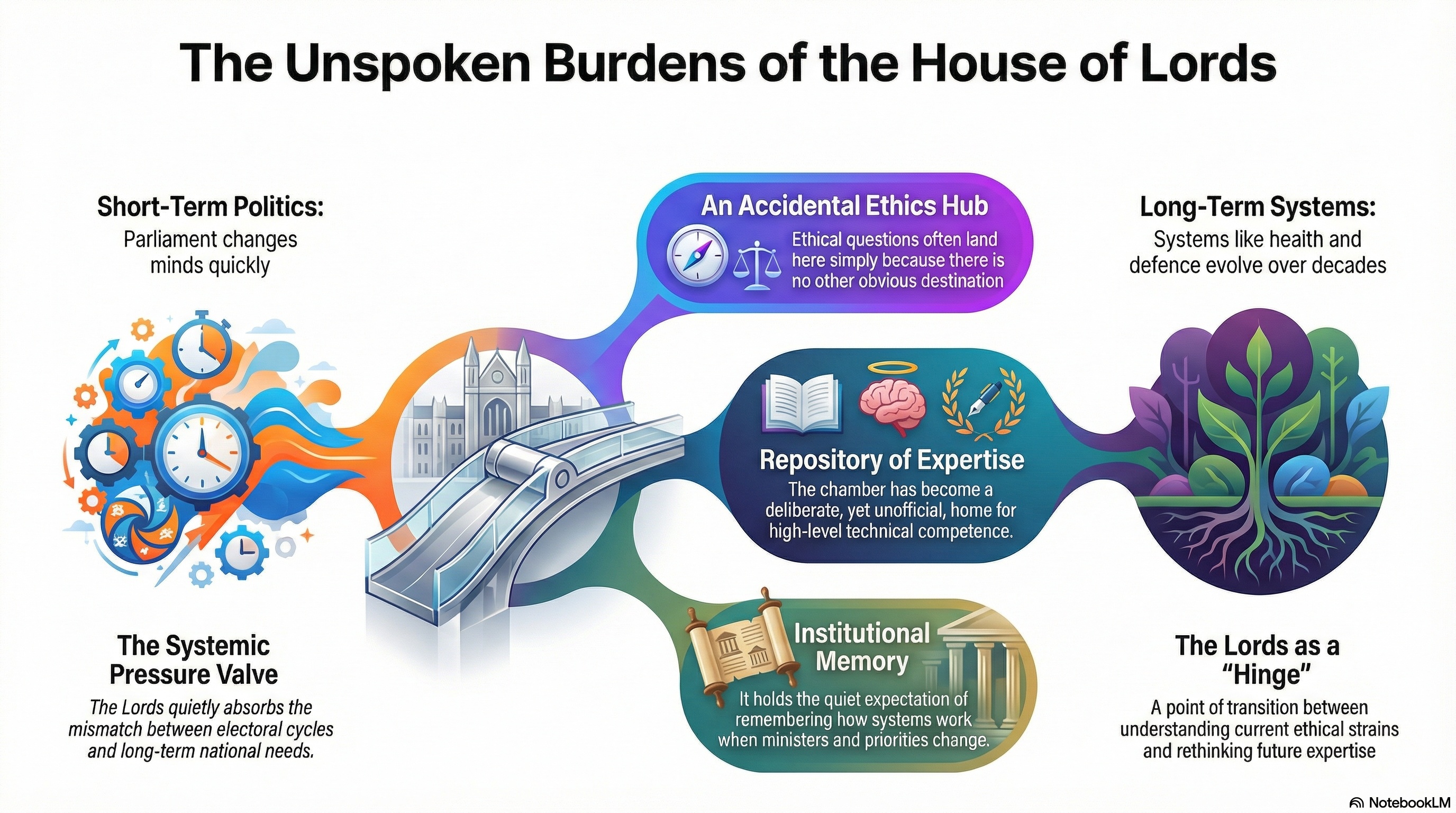
Ethical questions keep landing in the Lords. Not by design. Not because anyone decided that’s what it was for. But because there wasn’t anywhere else obvious for them to go.
That’s been the thread we’ve been pulling on so far.
But if we stop there, we’d be missing something important.
The Lords is carrying more than one extra job
Ethics isn’t the only thing that’s drifted into the House of Lords over time.
So has expertise.
So has institutional memory.
So has a quiet expectation that someone in the system will remember how things work when governments, ministers, and priorities keep changing.
We tend to talk about the Lords as if it’s just one thing — a revising chamber, an unelected check, a constitutional oddity. In reality, it’s been used as a kind of catch-all for roles Parliament hasn’t quite decided where to put.
That’s why debates about it so often talk past each other.
Some people are really arguing about democracy and legitimacy.
Some are worried about technical competence and long-term systems.
Others are reacting to ethics, values, and moral authority.
We keep having those arguments through the Lords, instead of asking which of them actually belong there in the first place.
Long systems, short politics
One of the pressures we haven’t really looked at yet is time.
A lot of the systems Parliament legislates for — health, defence, courts, policing, social care, infrastructure — don’t operate on electoral cycles. They evolve slowly. They accumulate rules, habits, and constraints over decades.
Parliament, by contrast, is designed to change its mind quickly. Governments come and go. Ministers rotate. Priorities shift.
Somewhere along the line, the Lords became the place where that mismatch was quietly absorbed. Former ministers, senior professionals, and people with long experience ended up there not because it was elegant, but because it was convenient.
That’s another role the Lords was never cleanly designed to play — but has ended up playing anyway.
Which means there’s more to rethink
So before we try to “wrap things up”, there’s another set of questions we need to look at properly.
Questions like:
- Is the House of Lords really the best place to park long-term expertise and institutional memory?
- What would it look like to represent that expertise deliberately rather than accidentally?
- And separately from all of that, how else could the Lords itself be structured — appointed, elected, mixed, time-limited — if we were designing it now rather than inheriting it?
Those are different questions from the ethics one. They overlap, but they aren’t the same.
And if we don’t look at them on their own terms, we’ll just end up folding everything back into the same unresolved argument.
So this isn’t the end
Think of this as a hinge.
We’ve spent the first part of the series understanding why ethics ended up where it did, and what problems that causes. Now we need to widen the conversation and look at the other pressures the Lords is carrying — and what options actually exist for dealing with them.
Only after that will it make sense to try and pull the whole picture together.
So, next:
not ethics again —
but expertise, institutional memory, and what we quietly expect the Upper House to hold steady when everything else is moving.
That’s where we’ll pick it up.


This is post 14 of a series – Let’s Rethink The Lords, looking at the Upper House in the English system of politics. It will cover what it is, why it is, how it has changed, how other countries do it and potentially what could be done to improve ours.
There will be podcasts over at hysnaps-political-investigations providing explainers and summary videos at youtube @hysnapmmh, these are usually released a week or two after the Blog Post.
Discover more from Hysnaps Politics, Gaming, Music and Mental Health
Subscribe to get the latest posts sent to your email.

