If we step back from the ethics question for a moment, there’s another role the House of Lords has quietly picked up over time.
It’s become the place where long experience goes to sit.
Not formally. Not because anyone designed it that way. Just because, little by little, it became obvious that Parliament still needed access to certain kinds of knowledge — and the House of Commons, by design, isn’t very good at holding onto it.
Former health ministers. People who’ve run large public bodies. Senior figures from the courts, defence, policing, social care, infrastructure. They tend to end up in the Lords because those systems don’t reset every five years, even though politics does.
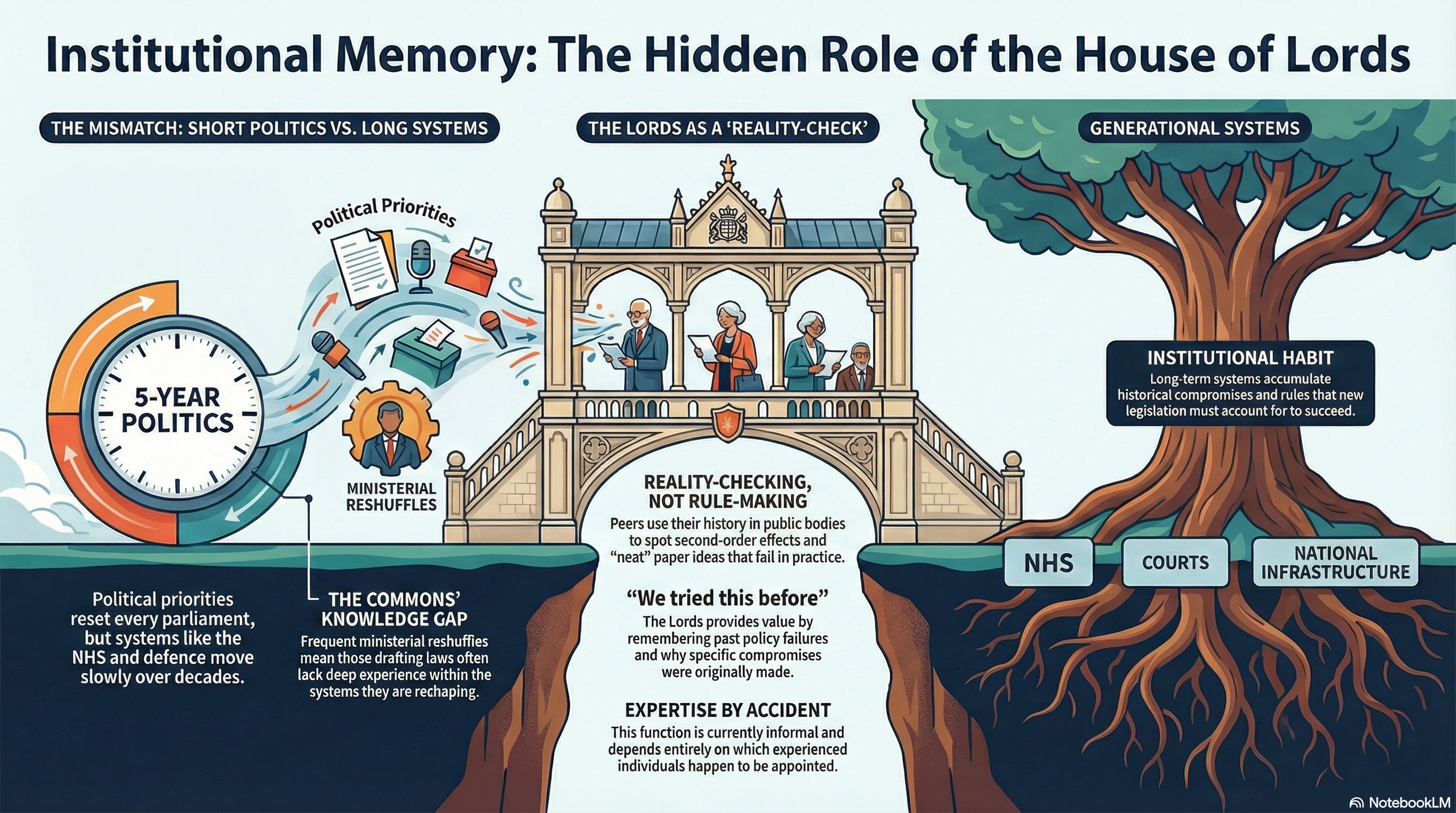
Long systems, short politics
Most of the systems Parliament legislates for don’t really care about elections.
The NHS doesn’t start again with each Parliament. The courts don’t reinvent themselves every time there’s a new manifesto. Defence procurement, policing frameworks, social care funding, infrastructure planning — these things move slowly, if they move at all.
Over time, they accumulate rules, workarounds, institutional habits, and historical compromises. Decisions made decades ago still shape what’s possible now.
Politics, by contrast, has to move quickly. Ministers rotate. Departments get reshuffled. Priorities change. Sometimes the people drafting legislation haven’t spent much time inside the systems they’re reshaping.
That mismatch isn’t a failure. It’s just how representative democracy works.
But it does leave a gap.
How the Lords ended up filling that gap
Somewhere along the way, the House of Lords became the place where that gap was absorbed.
Not because it’s uniquely wise. Not because peers are magically better informed. But because it’s one of the few places in the system where people can stay put long enough to remember how things used to work — and why certain choices were made.
So when legislation lands that affects a long-running system, it’s often in the Lords that someone pauses and says something like: we tried this before, or that clause interacts badly with something else, or this looks neat on paper, but here’s what happens when it meets reality.
Those moments don’t usually make headlines. They’re rarely dramatic. But they change bills more often than people realise.
What kind of expertise this actually is
It’s also worth being clear about what kind of “expertise” we’re talking about here, because it’s easy to misunderstand.
This isn’t about handing power to technocrats. It isn’t about bypassing democratic choice. And it certainly isn’t about people continuing to run systems they’re no longer accountable for.
Most of the value is much quieter than that.
It’s about spotting second-order effects that aren’t obvious at first glance. About understanding how rules interact once they’re embedded in real organisations. About remembering why certain compromises exist, and recognising when a tidy reform collides with messy reality.
That isn’t rule-making. It’s reality-checking.
The problem with doing this by accident
The trouble is that none of this is deliberate.
There’s no guarantee the Lords contains the right expertise at the right moment. There’s no clear sense of which policy areas are well covered and which barely are. And there’s no structure that ensures institutional memory is refreshed rather than slowly fading as individuals retire.
It depends on who happens to be there.
That works tolerably well when you’re lucky. It works badly when you’re not.
And because the whole thing is informal, it’s also hard to explain or defend. From the outside, it can look like nothing more than an unelected chamber full of former insiders — even when the contribution being made is genuinely useful.
A role we rely on, without quite owning it
So we’re left in an odd position.
We rely on this function. We benefit from it. But we’ve never really decided whether the House of Lords is where it ought to live — or whether there’s a cleaner, more deliberate way of doing it.
That’s not a question about getting rid of expertise. It’s a question about whether we want to keep relying on chance and inheritance, or whether we want to think more carefully about how long-term knowledge and institutional memory should show up in our system at all.
That’s the thread we need to pull next.

This is post 14 of a series – Let’s Rethink The Lords, looking at the Upper House in the English system of politics. It will cover what it is, why it is, how it has changed, how other countries do it and potentially what could be done to improve ours.
There will be podcasts over at hysnaps-political-investigations providing explainers and summary videos at youtube @hysnapmmh, these are usually released a week or two after the Blog Post.
Discover more from Hysnaps Politics, Gaming, Music and Mental Health
Subscribe to get the latest posts sent to your email.

