
In the last post, we landed on a fairly uncomfortable place.
We rely on expertise and institutional memory far more than we tend to admit. We benefit from it when it’s there, and we notice when it’s missing. But we’ve never really decided where it should live, or how it ought to be represented. Instead, it’s drifted into the House of Lords because that was the easiest place for it to end up.
So the obvious next question isn’t whether expertise matters. It’s whether there’s a more deliberate way of making sure long-lived systems are properly understood when laws are written about them.
Not a grand redesign of Parliament. Not a technocratic takeover. Just something a bit cleaner and more intentional than what we have now.
Starting from something we already recognise
One helpful way to think about this is to look at how large organisations handle similar problems.
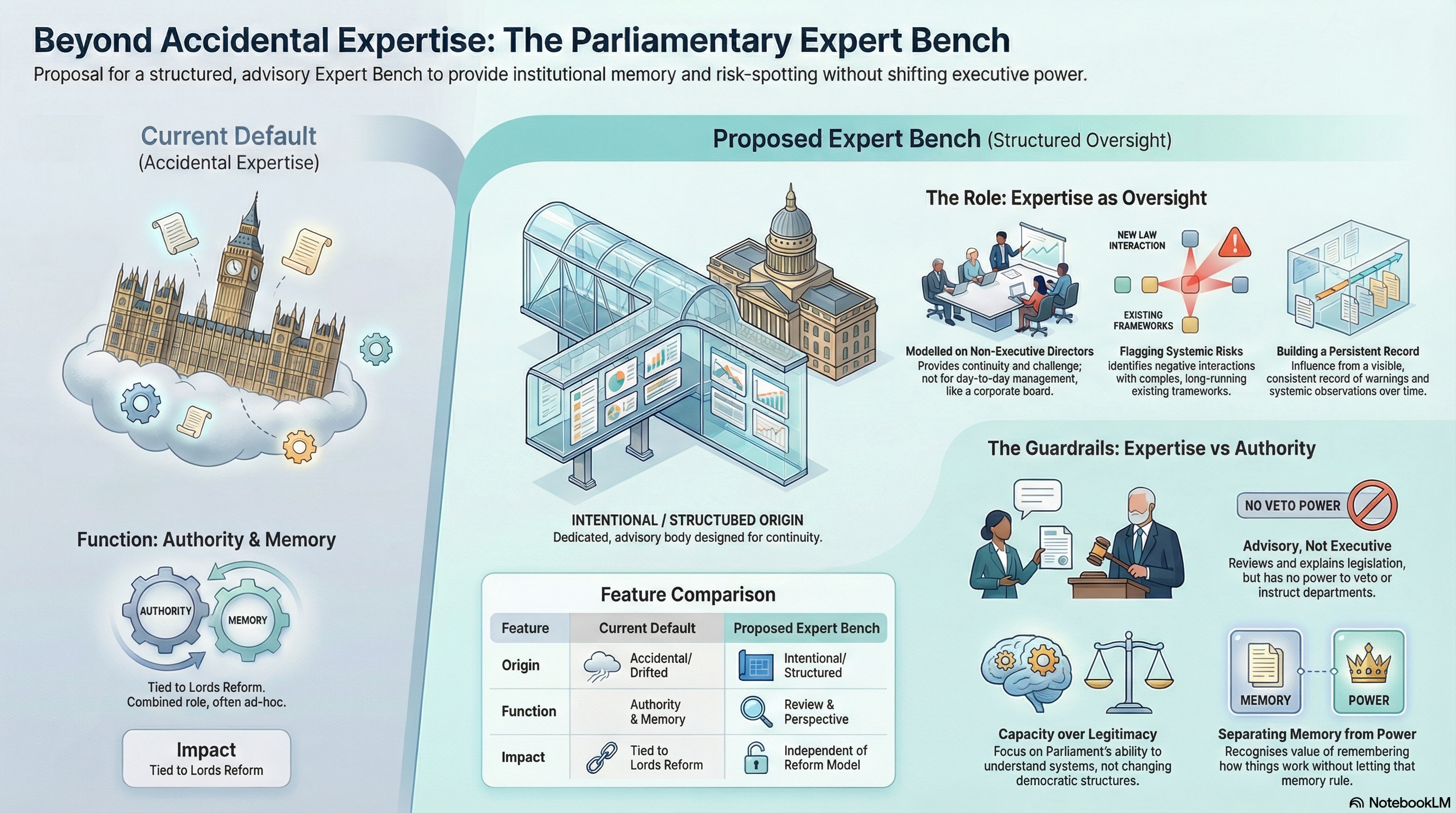
In the private sector, companies don’t rely entirely on whoever happens to be in charge at the moment. They use boards. Not to run things day to day, but to provide continuity, oversight, challenge, and memory.
Non-executive directors don’t manage staff or write operational plans. Their value lies in having seen similar situations before, understanding how complex systems behave over time, and being able to spot risks that aren’t obvious when everything looks tidy on paper.
That basic idea already exists in government too — it just doesn’t currently sit inside Parliament in any structured way.
What an expert or ALB bench might actually do
If we apply that logic here, an expert or ALB bench wouldn’t be about control. It would be about perspective.
Its role would be to look at legislation that affects a particular long-running system and ask what tends to happen when rules like this meet reality. That means flagging risks, pointing out interactions with existing frameworks, and drawing attention to long-term consequences that are easy to miss when the focus is on getting a bill through.
Much like non-executive directors, its influence would come from being visible and persistent rather than from issuing orders. It would sit there, saying the same careful things over time, building a record of what was known and what was warned about.
What it very deliberately wouldn’t be
This is where people understandably get nervous, so it’s worth being explicit.
An expert bench wouldn’t have executive authority. It wouldn’t issue instructions to departments. It wouldn’t veto legislation. And it wouldn’t be there to micromanage agencies or public bodies.
Its role would be narrower and quieter than that. It would review, question, and explain — not decide.
That distinction matters, because the value here isn’t in shifting power away from elected representatives. It’s in making sure decisions are taken with a clearer understanding of how complex systems actually behave.
How this relates to the House of Lords
Importantly, this kind of bench doesn’t replace the House of Lords, and it doesn’t depend on any particular model of Lords reform being in place.
It could sit within a reformed appointed chamber. It could exist alongside elected members in a mixed house. Or it could be a clearly defined subset mapped onto an otherwise unchanged House.
That flexibility is part of the point. This idea isn’t really about legitimacy or democracy — those questions still need to be addressed elsewhere. It’s about capacity.
It’s about whether Parliament wants a reliable way of hearing from people who understand long systems, without having to rely on who happens to be there by accident.
Why this is only one option
None of this magically fixes the House of Lords. It doesn’t settle arguments about election, appointment, or size. And it doesn’t remove the need for democratic accountability.
What it does offer is one way of separating experience from authority — of recognising that remembering how things work is valuable, without pretending that memory should rule.
Whether that function belongs inside the Lords, alongside it, or somewhere else entirely is still an open question.
But at least it’s now a question we can ask deliberately, rather than one we keep answering by default.


This is post 16 of a series – Let’s Rethink The Lords, looking at the Upper House in the English system of politics. It will cover what it is, why it is, how it has changed, how other countries do it and potentially what could be done to improve ours.
There will be podcasts over at hysnaps-political-investigations providing explainers and summary videos at youtube @hysnapmmh, these are usually released a week or two after the Blog Post.
Discover more from Hysnaps Politics, Gaming, Music and Mental Health
Subscribe to get the latest posts sent to your email.

