Up to now, we’ve been looking at the things that have gradually drifted into the House of Lords — ethics, expertise, institutional memory — and asking whether there might be cleaner ways of handling them.
But there’s a more basic question we’ve been carefully skirting since the start. What happens if we stop arguing about what the Lords has been, or what tradition tells us it ought to remain, and instead just look at it honestly? If we were designing an upper chamber today, from scratch, what could it reasonably be?
Not in theory. Not in a white paper. Just in the real world, with the constraints we already have.
A quick reality check before we get abstract
It’s worth grounding this in what’s actually happening now, because reform of the House of Lords isn’t some distant hypothetical.
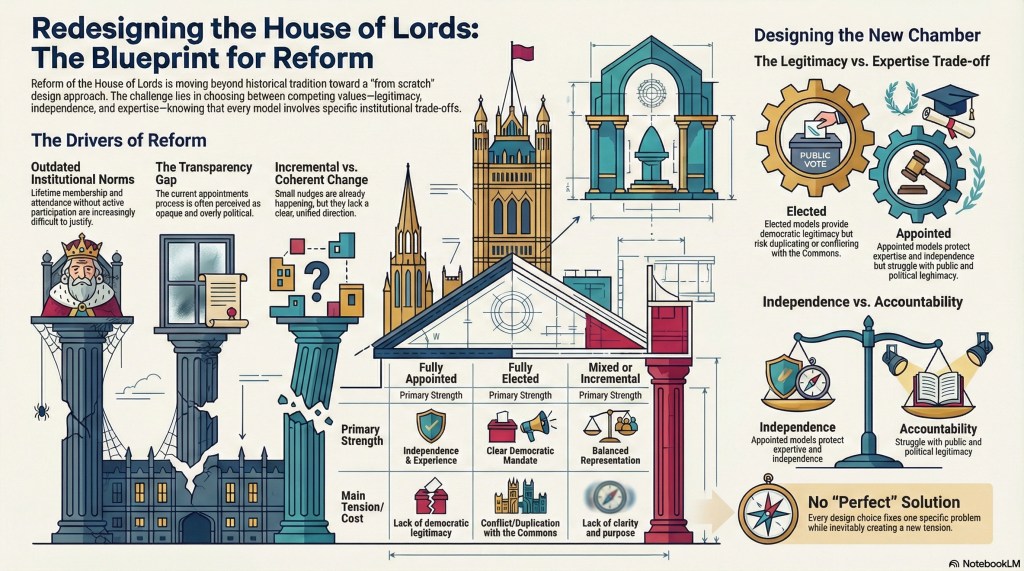
There’s already a broad acceptance that some things don’t sit comfortably anymore. Lifetime membership increasingly feels odd in a modern system. Attendance without real participation is hard to defend. And the appointments process, even when well-intentioned, often looks opaque and overly political from the outside.
Taken together, those pressures are already nudging the Lords toward something smaller, more time-limited, and easier to justify. Even without a grand redesign, change is happening by degrees.
What we’re really deciding is whether those incremental nudges add up to a coherent direction — or whether there are clearer alternatives that would make more sense if we were honest about what we want the chamber to do.
The options aren’t as stark as they’re often presented
When people talk about Lords reform, it’s often framed as a binary choice: appointed or elected, tradition or democracy. In practice, the design space is broader — and messier — than that.
There are fully appointed models that prioritise independence and experience but struggle with legitimacy. There are elected models that solve the legitimacy problem neatly but introduce duplication and political conflict with the Commons. Mixed chambers try to balance the two, but can end up unclear about what they’re actually for. And incremental reform avoids confrontation, but often avoids clarity as well.
What’s striking is that none of these options is obviously ridiculous — and none of them solves everything. Each one fixes a problem and creates a new tension somewhere else.
That’s why debates about the Lords tend to loop. People aren’t really disagreeing about whether reform is needed. They’re disagreeing about which trade-offs they’re willing to live with.
Why the earlier strands matter here
This is also the point where the earlier discussions stop being abstract and start to matter.
If ethical reasoning is handled somewhere else, the Lords doesn’t have to carry that weight by default. If expertise and institutional memory are represented deliberately, the chamber doesn’t have to rely on chance — on who happened to be appointed years ago and who hasn’t yet retired.
Once those pressures are eased, the question of Lords reform becomes simpler. Not easy — but simpler.
It stops being about trying to make one institution do everything at once, and starts being about choosing which mix of legitimacy, independence, expertise, and restraint we actually want from an upper chamber.
Where that leaves us
So this isn’t the moment to announce a verdict. It’s the moment where the shape of the choice finally becomes visible.
We can see the components. We can see how they interact. And we can see that different combinations would lead to genuinely different outcomes, not just cosmetic change.
All that remains is to pull those strands together and lay out the real options on the table — not as slogans, but as workable configurations, each with its own costs and consequences.
That’s where we’ll go next.

This is post 17 of a series – Let’s Rethink The Lords, looking at the Upper House in the English system of politics. It will cover what it is, why it is, how it has changed, how other countries do it and potentially what could be done to improve ours.
There will be podcasts over at hysnaps-political-investigations providing explainers and summary videos at youtube @hysnapmmh, these are usually released a week or two after the Blog Post.
Discover more from Hysnaps Politics, Gaming, Music and Mental Health
Subscribe to get the latest posts sent to your email.

