This finally feels like the moment where it makes sense to stop introducing new ideas and just look at the whole picture we’ve built up along the way.
Not to declare a winner. Not to arrive at a single, tidy answer. Just to be honest about what’s actually on the table now that we’ve taken the time to slow down and separate things out.
What we’ve really been doing
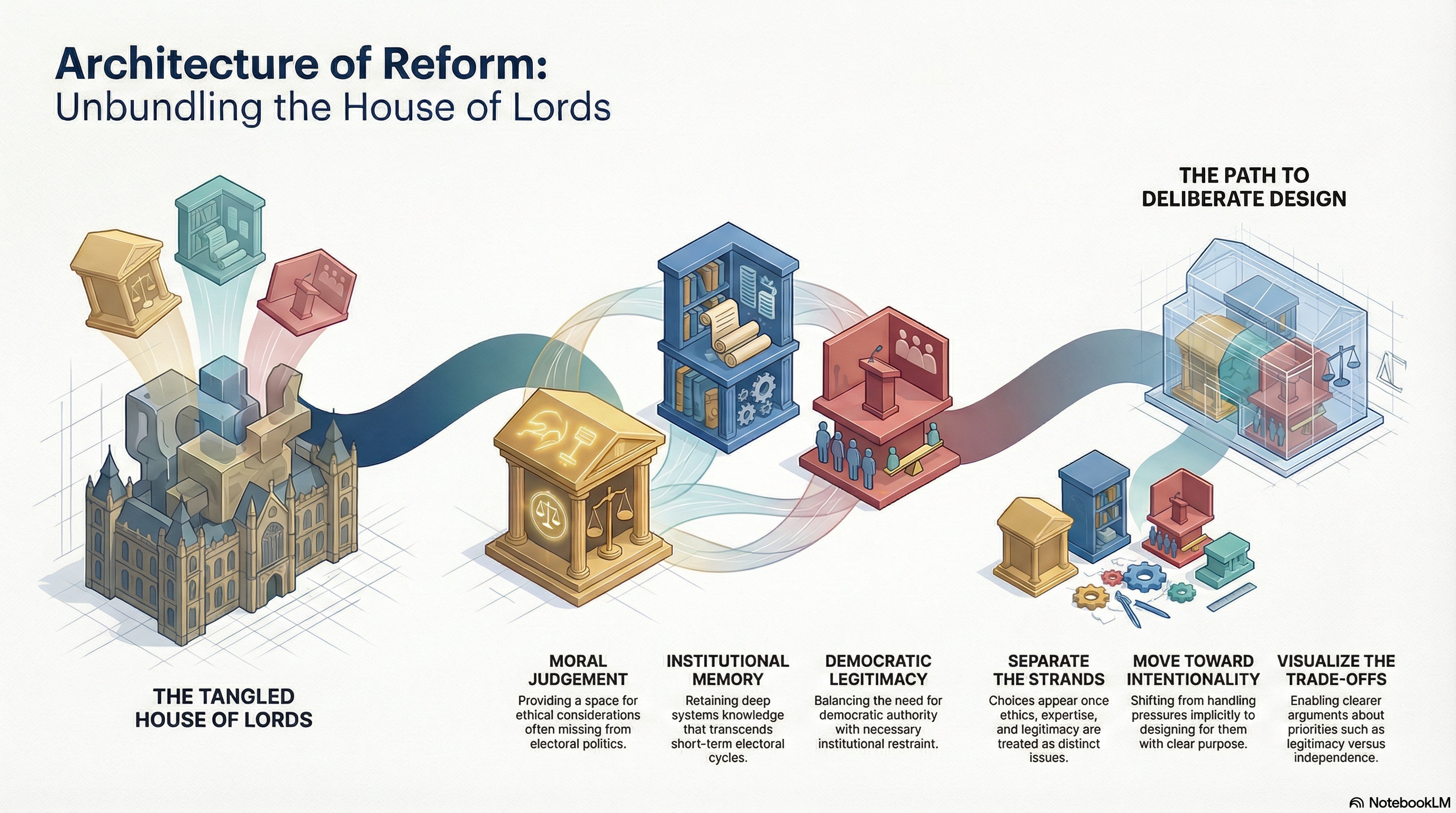
If we zoom out, this series hasn’t really been about arguing for one particular reform. What it’s been doing is pulling apart a set of questions that we’ve spent years bundling together.
We started by looking at the House of Lords as it actually operates — not as a symbol, not as a punchline, but as a working part of the system. From there, three different pressures kept coming into focus.
Ethics is one of them. Moral judgement, long-term harms, and value-laden decisions keep surfacing in the Lords because there hasn’t been a clearer place for them to go.
Expertise and institutional memory is another. Long-running systems don’t map neatly onto electoral cycles, so people who understand how things work over decades tend to accumulate in the one place that doesn’t reset every few years.
And then there’s the underlying question of what an upper chamber is actually for in a modern democracy — how much independence we want it to have, how much legitimacy it needs, and how much restraint we expect it to exercise.
Those are different problems. We’ve just been treating them as if they were the same one.
Once you pull them apart, choices appear
As soon as those strands are separated, the conversation changes.
Ethics doesn’t have to live in one place by default. It can stay within the Lords, handled as it is now — unevenly, sometimes awkwardly, but occasionally with real force. Or it can be given a clearer, more deliberate space of its own, feeding into Parliament without trying to overrule it.
Expertise and institutional memory don’t have to arrive by chance, depending on who happens to be appointed and who happens to stay long enough. They can be represented deliberately, through something like an expert or ALB bench, with long terms and soft powers that focus on explanation rather than control.
And the House of Lords itself doesn’t have to be frozen in its current form. It can remain appointed but with clear time limits. It can become a mixed chamber. It can move further toward election. Each option solves one problem and creates another — and none of them automatically dictates what happens with ethics or expertise.
The important thing is that these decisions don’t lock each other in. They can be combined in different ways.
What this series hasn’t done
It hasn’t pretended there’s a neutral, purely technical answer waiting to be discovered. It hasn’t assumed that better institutional design automatically produces better politics. And it hasn’t argued that tradition is either sacred or worthless.
What it has done is make the trade-offs easier to see.
Once those trade-offs are visible, disagreement becomes more productive. People can argue about priorities — legitimacy versus independence, speed versus caution, clarity versus flexibility — instead of talking past each other about whether the Lords is an anachronism or a safeguard.
Where that leaves us, for now
In the end, this hasn’t really been a series about the House of Lords at all.
It’s been about whether we’re willing to admit that our system already relies on ethics, expertise, and long-term thinking — and whether we want to keep handling those things implicitly, or start designing for them deliberately.
Nothing here demands a particular outcome. But it does remove a familiar excuse: that the problem is too tangled, too historical, or too strange to think about clearly.
Once we slow down and separate the questions, the shape of the choices becomes surprisingly clear.
And from there, at least, we’re finally arguing about the right things.

This is post 18 of a series – Let’s Rethink The Lords, looking at the Upper House in the English system of politics. It will cover what it is, why it is, how it has changed, how other countries do it and potentially what could be done to improve ours.
There will be podcasts over at hysnaps-political-investigations providing explainers and summary videos at youtube @hysnapmmh, these are usually released a week or two after the Blog Post.
Discover more from Hysnaps Politics, Gaming, Music and Mental Health
Subscribe to get the latest posts sent to your email.

