
Has the War on Drugs delivered what it promised? Looking at fifty years of UK policy, this post explores drug use, harm, and public cost — not to win an argument, but to ask whether “being tough” turned out to be an especially expensive way of managing a persistent human behaviour.
Author Archives: Hysnap - Gamer and Mental Health sufferer
Lets Rethink Policy-Making: Illegal Drugs – A cheaper alternative.
Let’s Rethink Policy-Making: Filthy Lucre
What happens if we stop pretending the illegal drugs market will disappear? Using conservative figures for England & Wales, this post explores how costs, criminal profits, regulation, and incentives interact — and why redesigning where money flows may matter more than repeating moral arguments.
Lets Rethink Policy-Making: Illegal Drugs – Who’s Been Getting Rich.
Let’s Rethink Policy-Making: The Filthy Lucre.
What happens when the public cost of managing illegal drugs is larger than the market itself? Looking at England & Wales data, we explore why drug use persists, how costs accumulate across health, crime and social services, and why pretending demand can be driven to zero may be one of the most expensive policy assumptions we make.
Lets Rethink Policy-Making: what Happened Elsewhere?
Ok — so before we go any further, it’s probably worth asking a fair question.
Is this just how things work everywhere?
Or is there something particularly British — or English — about the way we’ve handled it?
Up to now, we’ve mostly been looking at the UK. That’s deliberate. It’s the system we live in, pay for, and argue about. But it also risks leaving us with a blind spot.
So now feels like the right moment to widen the lens.
Let’s have a look at what’s happened elsewhere — maybe we find good examples, maybe someone has cracked it — or maybe different choices just led to different kinds of mess.
Because if everyone ended up in the same place, we might just be looking at an unavoidable problem.
But if some countries ended up doing noticeably better — or noticeably worse — then what we’re really looking at is design.
The Longevity Burden
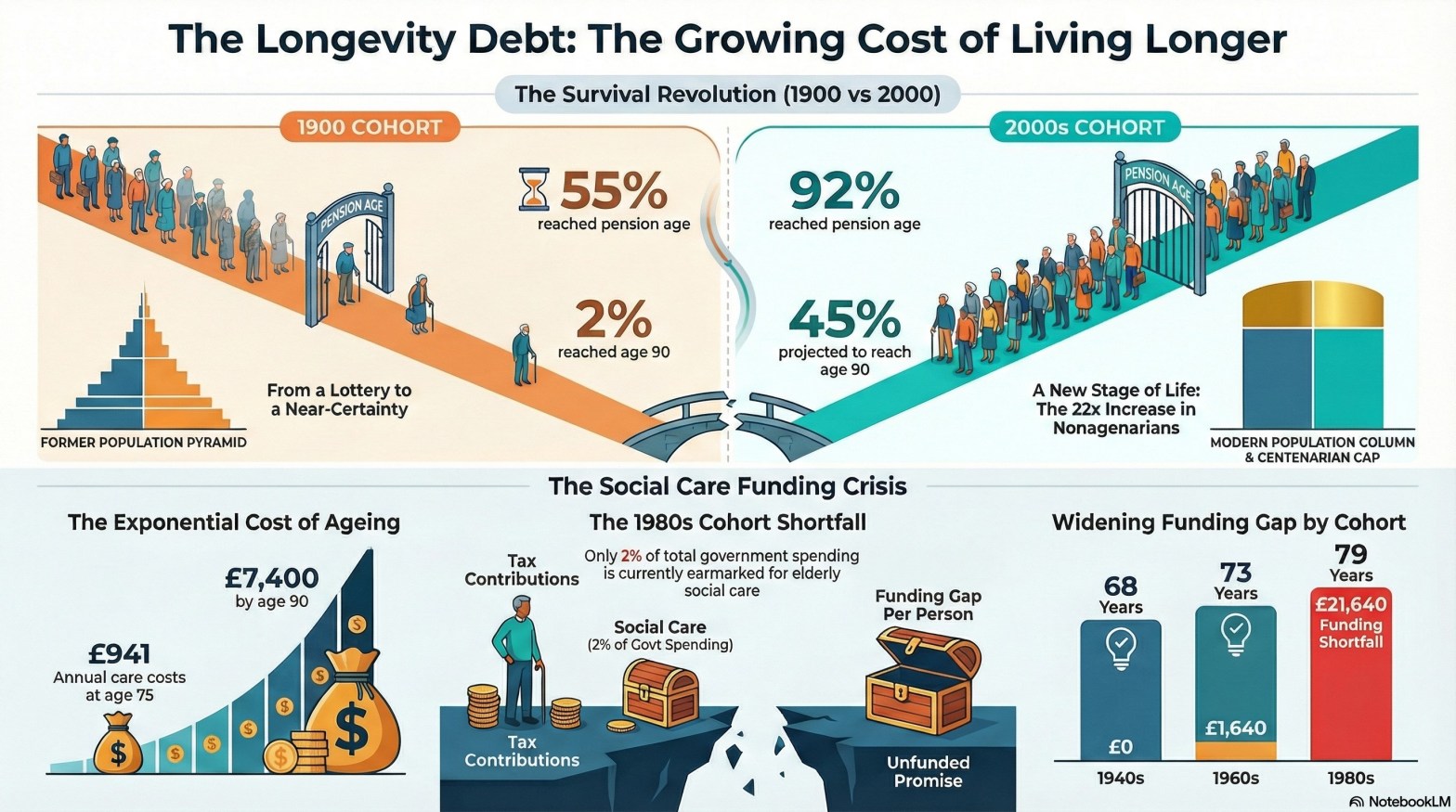
So I thought I’d create a nice Infographic for the 2 post I wrote looking at the impact of longer lives on the UK state pension, oh and add links to them and the podcasts. The Infinite Horizon: When Living Longer Becomes a Debt to the Future The Longevity Burden: Why Longer Lives Are Straining Social CareContinueContinue reading “The Longevity Burden”
Lets Rethink Policy-Making: Spotting the Patterns.
Before policies become expensive and hard to unwind, there are usually warning signs. This post explores how to spot them early — not by arguing, but by paying attention to what actually happens once policy meets real life.
Lets Rethink Policy-Making: Migration and Trafficking
Migration and trafficking are often treated as moral or enforcement failures, but evidence suggests they are shaped by incentives and policy design. This post explores how restrictive migration systems create shadow markets, increase exploitation, and shift costs elsewhere rather than reducing movement or harm.
Lets Rethink Policy-Making: Sex Work
Sex work policy is often driven by moral discomfort rather than evidence. This post explores what actually happens when sex work is criminalised, how vulnerability increases when activity is pushed out of sight, and why punishment often concentrates harm instead of reducing it.
Lets Rethink Policy-Making: Drugs
Drug policy is often framed as a battle to eliminate demand — but decades of evidence suggest something else happens instead. This post explores how prohibition reshapes markets, increases risk, concentrates harm, and quietly shifts costs elsewhere when punishment becomes the primary response.
Lets Rethink Policy-Making: Why Punishment Doesn’t Seem to Work.
Punishment feels like a decisive response when behaviour worries us — but it often doesn’t work the way we expect. This post explores why punishment adapts behaviour rather than eliminating it, how incentives shape enforcement, and why costs quietly grow elsewhere when policy relies too heavily on penalties.
