I thought it may be time to outline why I am tapping away at my keyboard producing this plethora of posts on politics.
A Note on How I Approach Politics
This site includes a growing body of writing on politics — but not in the usual sense.
It isn’t party-aligned, campaign-driven, or written to persuade people to adopt a particular position.
The work exists because I’m interested in how political systems behave over time, especially when outcomes repeatedly surprise or frustrate the people operating within them.
What I’m trying to understand
Most of the political posts here circle around a small set of questions:
- Why do well-intentioned systems so often produce unwanted outcomes?
- What incentives quietly shape behaviour, even when nobody is acting in bad faith?
- Why do some problems feel familiar every time they resurface?
- What gets lost when political debates focus on people rather than structures?
These aren’t new questions — but they’re often crowded out by louder, simpler arguments.
How the writing works
The approach is deliberately unhurried.
Posts tend to:
- step back from the news cycle
- focus on mechanisms rather than moments
- use evidence to illuminate, not to prosecute
- leave space for uncertainty rather than forcing conclusions
The aim isn’t to win arguments.
It’s to make certain patterns easier to see once they’ve been pointed out.
Perspective, not positioning
This work isn’t written from a purely theoretical standpoint.
My professional background includes time spent inside large public-sector and regulated systems, where policy intent, operational reality, and human behaviour don’t always line up neatly.
That experience mainly taught me caution:
- about simple fixes
- about moral certainty
- and about assuming that bad outcomes require bad actors
It also shaped my interest in incentives, drift, and unintended consequences — themes that recur throughout the posts.
Who tends to find this useful
People who engage with this writing often include:
- practitioners who work inside political or regulatory systems
- readers who care about outcomes more than narratives
- people who are politically engaged but wary of tribal framing
- organisations that value reflection as much as advocacy
Agreement isn’t assumed — or required.
Why this exists at all
Politics has become increasingly loud, fast, and adversarial.
A lot of people disengage not because they don’t care, but because the conversation feels exhausting or unsafe.
This work is a small attempt to slow things down.
To create space for:
- curiosity without naivety
- disagreement without hostility
- and thinking without immediately needing to land somewhere
If it helps others reflect on the systems they’re part of — that’s enough justification on its own.
A range of my Political Posts are available on this page.
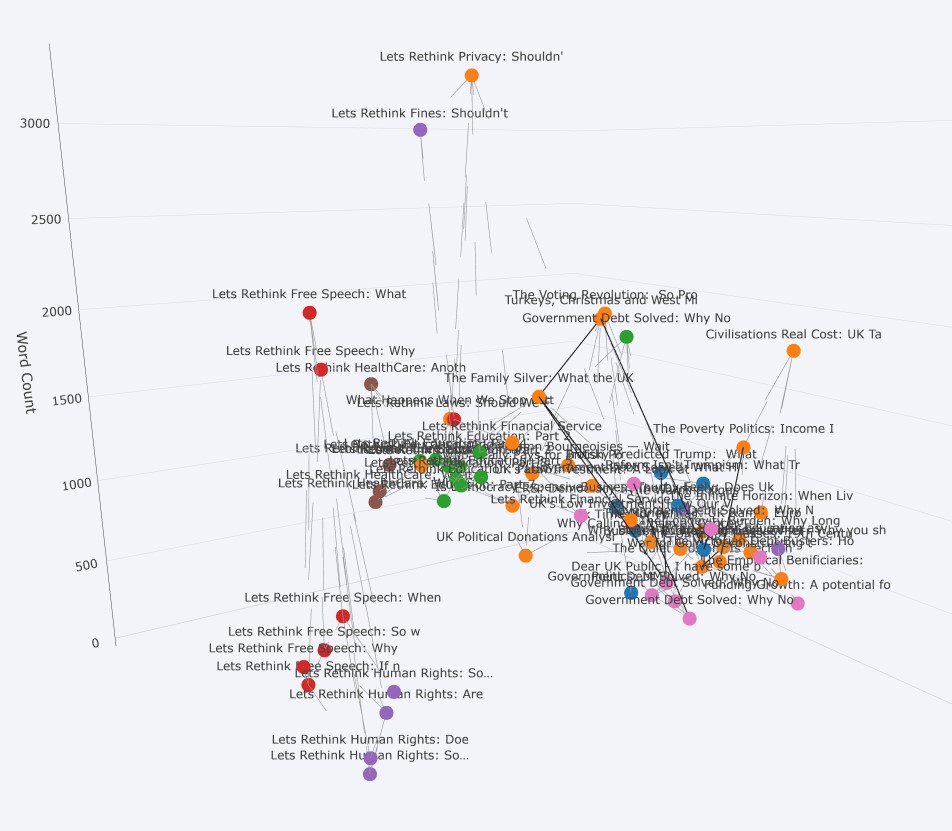
Open the interactive 3D mindmap